
Want to build a moat around your business to fend off competition?
Moats have the power to give you a major edge and make you immune from competition.
You might think of moats being exclusive to large Fortune 500 companies like Amazon or Coca-Cola, but they are just as critical if you are a small company.
No matter your size, you have the ability to create multiple moats within your business. The first key to building a moat is to become aware of what’s possible, which is what we’re going to focus on today.
In this article, I’m going to cover seven highly effective moats and how you can create them.
Why Build a Moat: How Do Moats Create a Competitive Advantage?
Let’s start with defining what a moat is.
In business, the term “moat” refers to a competitive advantage that sets a company apart from its competitors. This could be anything from a unique selling proposition to a well-known brand name.
A wide moat around your business can make it difficult for competitors to encroach on your market share. This gives you a significant leg up in the marketplace.
Warren Buffet and Charlie Munger popularized the phrase. here’s a quick primer from an old Berkshire Hathaway shareholders meeting:
In the 20th century, many of the largest companies in the world were purely built on moats of scale. As one example, John Rockefeller built his monopoly by buying up competitor refineries and creating a global distribution network. Eventually, Standard Oil controlled about 90% of all the refineries and pipelines in the country and was able to set its own prices.
As powerful as moats were back then, things have changed dramatically in the years since, with technology playing a big factor.
Although they may be less visible, moats in the 21st century are far more powerful than old barriers like manufacturing capability and capital.
7 Moats: Types of Competitive Advantage
- Economies of Scale
- Counter Positioning
- Switching Costs
- Brand
- Network Effects
- Cornered Resource
- Process Power
Economies of Scale
A company that enjoys economies of scale has lower per-unit costs than its competitors because it produces in such large volumes. As production volume increases, the cost per unit declines, which provides a powerful advantage.
This type of competitive advantage is often seen in industries where there are high fixed costs, such as manufacturing or transportation.
To create economies of scale in your business, you need to be able to increase your production levels without incurring disproportionately high costs. This could mean investing in new technology or automating your manufacturing process.
A couple examples of scale:
- Density of distribution network: the more customers in a distribution network, the cheaper the delivery cost (i.e. UPS)
- Purchasing economies: large scale buyers get better deals (i.e. Costco)
When your company is able to produce more output per unit of input than your competitors (i.e., you’re more efficient), you have an economies-of-scale moat. This type of advantage often results in lower costs, which can be passed on to customers in the form of lower prices. As an added bonus, lower prices can make it more difficult for competitors to enter the market.
Counter Positioning
Counter positioning involves embracing a new, superior business model that competitors can’t match due to the anticipated damage to their existing business.
In other words, you find a way to do things better, faster or cheaper than your competitors, and they can’t (or won’t) switch to your model because it would be too disruptive or costly for them.
Kodak and Blockbuster are two well-known companies that succumbed to counter positioning from smaller rivals and were never able to recover.
A couple more examples to make this real:
- If you owned a chain of car washes and switched from a manual process to an automated one. Your competitors could match your prices, but they wouldn’t be able to wash cars as quickly or cheaply as you could. As a result, they would eventually go out of business, leaving you as the dominant player in the market.
- If you starting selling products via subscription (like Birchbox). This type of business model is counter to the traditional retail model, where customers buy products outright. The subscription model is more efficient and waste-free, which gives the company a competitive advantage (not to mention increasing its valuation).
If you’re on the small side, counter positioning can be an effective strategy to offset the scale advantage that your larger competitors might have.
To implement counter positioning, think about how you can leverage a business model that competitors can’t easily replicate. One option could be to focus on a tighter niche market that you can deliver a superior outcome.
Where can you stand out? There’s always a different angle you can take – think Five Guys vs. McDonald’s.
How can you do things differently?
To successfully counter position, you need to be able to understand your costs well and have a clear picture of where your company sits in relation to the competition.
Switching Costs
Switching costs are the costs incurred by a customer when they switch from one product or service to another. These costs can be financial, such as an early termination fee, or they can be psychological, such as the inconvenience of learning how to use a new product.
This type of moat exists when it would be costly for a customer to switch from your company’s product or service to a competitor’s. Switching costs come into play when customers expect a greater loss than the value they gain from switching to an alternate solution.
High switching costs can create a barrier to entry for competitors and make it difficult for customers to switch to a new provider, even if the new provider is offering a better product or service at a lower price.
One example is on-site enterprise software used by large corporations. The initial implementation is often very expensive, time-consuming, and requires a great deal of customization. Even if a better option comes along, the idea of replacing this software isn’t appealing because of the headaches and money involved to switch.
To create high switching costs in your business, think about what you can do to make your product or service more difficult to replace:
- What can you do to increase the perceived value of your offering?
- Can you providing training and support to help customers use your product?
- Can you create raving fans? If you have developed strong relationships with your customers, they may be less likely to switch to a new provider.
- Can you make your offerings more integrated with other products or services?
- Can you offer incentives to keep customers from leaving?
- Can you create a network effect, where the value of your product or service increases as more people use it?
By making it more difficult and costly for customers to switch to a competitor, you can build a strong moat around your business.
Brand
It might not be a surprise, but a strong brand can create a wide moat for your business.
If your product has a higher perceived value due to reputation and prestige, you can charge more than the exact same product from another company.
If we take a look at Warren Buffet’s portfolio companies, we see quite a few impressive brands:
- Amazon
- Apple
- Coca-Cola
- Johnson & Johnson
- Kraft
- Visa
- American Express
Many of these brands sell commoditized goods no different than their competitors. Customers are making a buying decision purely based on the brand.
Customers are more likely to buy from a company they know and trust than from a unknown competitor. Brand equity can also make it easier to charge higher prices, since customers are willing to pay more for a product they perceive as being high-quality. As a side benefit, brands also give customers greater peace of mind and confidence.
Tiffany’s is one great branding example we can all learn from.
Their customers are not only loyal, they’re willing to pay a significant premium for the same diamonds they could find elsewhere. Tiffany’s is instantly recognizable and they’ve masterfully curated their image in the marketplace.
When you purchase from a company like Tiffany’s, you aren’t just buying jewelry, you are buying into the luxurious lifestyle and reputation they have created.
A strong brand can create a moat around your business that keeps customers coming back, even when there are cheaper options on the market.
Here are a few tips for building a brand moat within your business:
What do want to be known for?
In order to create a strong brand for your business, start by thinking about what you want your company to be known for.
Are you the low-cost provider? The high-end luxury option? The fastest in your industry?
Your branding should reflect these aspirations. Consider your target market and what they are looking for in a product or service.
Elicit good feelings
To build brand equity, you need to focus on creating positive associations with your brand in the minds of consumers. This could involve marketing campaigns, social media engagement, and providing exceptional service.
Investing in activities like market research, advertising, and public relations can pay off in the form of increased brand awareness and customer loyalty.
Keep your branding consistent
Your branding should be consistent across all channels, from your website to your social media profiles to the way your employees answer the phone.
That means using the same logo, colors, and style across all of your marketing materials, from your website to your business cards to your social media accounts.
Consistent branding makes it easier for customers to recognize and remember your business. It also conveys a sense of professionalism and quality that can help you stand out from the competition.
Build a strong reputation
Another key to building brand equity is to build a strong reputation for your business. You can do this by providing excellent customer service, delivering quality products or services, and living up to your promises. You’ll quickly attract referrals and strong word of mouth.
It’s also important to manage your online reputation. Make sure you’re monitoring what people are saying about your business online, and responding quickly and appropriately to any negative reviews or comments.
Building brand equity takes time and effort, but it’s well worth the investment.
Network Effects
Arguably the powerful moat in business is what’s referred to as network effects. This occurs when the value of a good or service increases as more people use it.
You’ve probably heard the classic examples of social networks like Facebook and Twitter. The more people who join these networks, the more valuable they become to each individual user, since they provide access to a larger pool of potential friends and contacts. Many Silicon Valley unicorns (Airbnb, PayPal, eBay, Uber, LinkedIn) today leverage network effects by bringing masses of people together.
Network effect is a powerful force, and it’s one of the key reasons why networks tend to grow exponentially. Once a network reaches a critical mass of users, its growth can become self-perpetuating: each new user makes the network more valuable for all the other users, which encourages more people to join, which in turn makes the network even more valuable, and so on.
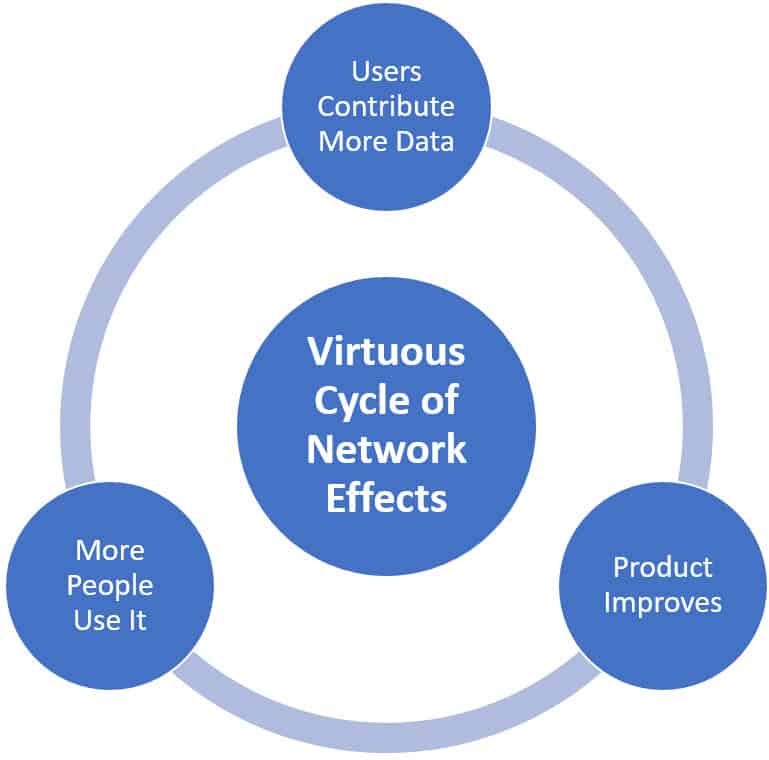
This feedback loop can lead to explosive growth: Facebook went from zero to 200 million users in just five years.
Each time a buyer or seller gets added to eBay, it gets more useful. Although it’s invisible, each incremental user adds value to other users. Eventually this reaches a tipping point and it doesn’t make sense for users to list or go buy anywhere else.
When Uber gets more riders, this quickly attracts more drivers, which lowers wait times – this process acts in a perpetual circle. Suddenly the status quo is flipped on its head and the traditional taxi industry is disrupted.
The network effect is also why it’s so difficult for these types of businesses to get off the ground: they need to reach a critical mass of users before the network effect can take hold. This is why most online networks are “winner-takes-all” markets: the network that manages to get the most users will usually end up being the only one that survives.
While network effects are hard to get going and require major effort up front, the magic happens once you get enough momentum.
These virtuous cycles help companies attain wealth over decades and competing with them becomes virtually impossible.
Let’s walk through some ways you can harness network effects to build the ultimate moat around your castle.
Strategies to Build Network Effect
Get more reviews:
Encourage customers to leave reviews on Google, Facebook, Yelp etc. These reviews can help attract new customers, as they provide social proof that your business is reputable and trustworthy.
Once you get a critical mass of reviews, it becomes incredibly hard for your competitors to compete. Reviews continue to compound and can help your SEO efforts to climb the first page of Google.
Make it easy for customers to leave reviews by providing links on your website and in your email signature. You can also send follow-up emails after a purchase and ask customers to leave their feedback.
Leverage data and feedback loops:
The more data and feedback loops you have, the quicker you learn and get better.
If there is knowledge or data in your business getting thrown away, you’re losing internal network effects. Think about how you can better accumulate useful data that would be very difficult for others to replicate.
Build community:
Similar to Facebook, as you build a community, each new member attracts more and more members.
This quickly turns into a great retention strategy and becomes even stronger if your competitors don’t have a similar community of loyal fans.
Focus on speed and reduce friction:
Take away pain points for your customers when using your service. Google figured this out in the early stages and it helped them grow into the ultimate gatekeeper of information on the internet.
Google focused on utilizing the data of all their searches to help you find what you’re looking for faster than alternatives like Yahoo and MSN. Their home page is plain white so it loads faster.
This had massive implications for users: if you can find what you’re looking for quicker on Google, that’s the search engine you’ll use. Reducing friction continues to Google them amass a massive database of user behavior, so they know what their users are searching for and click on.
This continues to help their search algorithm get smarter over time and attracts more users.
How can you increase the speed to help get customers what they want?
What friction can you reduce for customers that will give you an advantage in the marketplace?
Cornered Resource
Cornered resources involve a business that has preferential access to a coveted resource that enhances value.
This can be a wide range of things, including property rights, key talent/expertise, proprietary technology, patents, and trademarks.
One classic example of a cornered resource is De Beers’ control of the world’s diamond supply. For many years, De Beers had a monopoly on diamonds, which allowed them to keep prices high and maintain their position as the world’s leading diamond company.
Today, De Beers still has a large share of the diamond market, thanks to their control of key diamond mines and their expertise in marketing and selling diamonds.
In order for a company to have a cornered resource, it needs to have a competitive advantage that can’t be easily replicated or purchased by its competitors.
If your company has a cornered resource, make sure you’re doing everything you can to protect and capitalize on it. This includes:
- Investing in research and development
- Maintaining a strong legal team
- Protecting your intellectual property with patents, copyrights, and trademarks
- Hiring and retaining top talent
Process Power
A business with process power has internal activities and processes that enable lower costs and/or a superior product.
In order to have process power, a company needs to have a competitive advantage in the way it designs, produces, and/or distributes its products or services.
For example, Walmart has process power thanks to their highly efficient supply chain and distribution system. This allows them to sell their products at lower prices than their competitors, which gives them a significant competitive advantage.
Another example of process power is Toyota’s lean manufacturing process, which allows them to produce high-quality cars at lower costs than their competitors.

Process power can typically be matched (eventually), but only by a competitor willing to make a dedicated commitment over a prolonged time period. As a result, process power can provide a company with a significant competitive advantage for many years.
Something you can do in your business: focus on crafting internal processes that are nuanced and difficult to copy from the outside.
If you’d like to go deeper in any of these categories, I’d recommend checking out 7 Powers: Foundations of Business Strategy, which is an excellent book on business strategy.
Companies that Control the World with Durable Competitive Advantages
As you think about how you can apply the above strategies to your business, here are some use cases of companies with strong moats we can all learn from.
Apple
Apple has done a brilliant job building a moat by creating an ecosystem of products and services that work together seamlessly.
It’s not only pricey for customers to switch to a competitor, but it’s awfully difficult for customers to escape the Apple ecosystem. Apple’s competitive advantage comes from its ability to keep customers locked-in to its platforms.
If a consumer has MacBook, you can be confident that person also has AirPods and an iPhone.
The more Apple products that you own, the more benefits you can derive from each product due to how compatible and well-integrated they are (the whole is greater than the sum of the parts). As a result, Apple product users tend to be some of the most loyal, recurring customers with a high customer lifetime value.
Another moat is Apple’s control of the iOS operating system (example of a cornered resource). Because iOS is only available on Apple devices, it gives Apple a big advantage over its competitors in the smartphone market.
Apple can dictate the terms and features of its operating system, and developers have to design their apps accordingly. This gives Apple a big leg up in attracting the best app developers to its platform.
Netflix
- Scale: Netflix has over 150 million paying subscribers and is available in 190 countries, which allows them to invest more in content than any of their competitors. Content providers want their content to be seen by as many people as possible, so they’re more likely to give favorable terms to Netflix.
- Data advantage: similar to the Google example we covered, Netflix has a huge data advantage, as it knows what its customers are watching and when they’re watching it. This allows them to make better decisions about what content to invest in and how to market it.
- Investing in original content: Netflix continues to invest heavily in original content, which gives it a competitive advantage (much higher margins) over other streaming services that rely primarily on licensed content. Netflix spends billions of dollars every year on original content, and this investment is paying off handsomely.
- Efficient operations: Netflix has a very efficient operation, which gives it a cost advantage over its competitors. Netflix uses cutting-edge technology to deliver its content quickly and efficiently. Netflix developed their own CDN (Content Delivery Network), which helps them deliver content to customers faster (and with higher performance) than their competitors.
Amazon
Amazon has quite a few competitive advantages that have allowed it to become the largest e-commerce retailer in the world.
- Scale: Amazon has over 310 million active customers and operates all over the world. This gives Amazon a big data advantage. They know what their customers are buying and when they’re buying it. This allows them to make better decisions about which products to stock and how to price them.
- Very efficient fulfillment network: They have over 175 fulfillment centers around the world and use a sophisticated algorithm (Fulfillment by Amazon, or FBA) to determine the best way to get products to customers. This gives them a big advantage over their competitors in terms of delivery times and costs. It’s raised the bar for consumer expectations around shipping times (now waiting a week for a product feels like an eternity).
- Extremely strong brand: Customers trust Amazon to deliver on its promises of low prices and fast shipping. This brand equity allows Amazon to charge higher prices for some items than their competitors (because customers are willing to pay a premium for the convenience and reliability that Amazon offers).
Finally, Amazon has a very strong competitive moat in the form of its Prime subscription service. Prime subscribers spend more money on Amazon than non-subscribers and are less likely to defect to a competitor. Similar to Apple, once someone is in the Amazon ecosystem, it’s incredibly tough to get them out.
This gives Amazon a big advantage in terms of customer loyalty and retention.
Building Your Unfair Competitive Advantage
Even though its often invisible to casual observers, building a wide moat allows you to create an insurmountable lead against others in your industry.
As we covered, there are many different types of moats that you can create, and the best one for your business will depend on your unique strengths as a company.
I urge you to take the time to think deeply about how you can incorporate at least one of the moats we covered within your business.
Building a wide moat helps to protect your business, stay ahead of the competition, and will set you up for long-term success.
If you have any takeaways or questions, I’d love to hear from you in the comments.



