
As a business owner, there’s a lot to think about when it comes to your exit strategy and selling your business.
One option you might consider is an earn out structure, especially if you’re gridlocked in negotiations with a potential buyer.
In this post, I’ll breakdown exactly what earn outs are, the potential risks involved, and 11 things you don’t want to miss if you’re thinking about an earn out.
What is an Earn Out Arrangement?
An earn out arrangement is a type of contingent payment structure that is commonly used in the sale of a business. Under an earn out arrangement, the seller of a business agrees to receive a portion of the purchase price based on the future performance of the company.
Earn out clauses are very common and were used in 27% of acquisitions during 2020.
Depending on the scenario, earn outs can be an attractive option for both buyers and sellers – they allow the buyer to potentially pay a lower upfront price while still offering the seller the opportunity to benefit from the continued success of their business.

Useful for disagreements on future performance
Earn outs are often used to bridge a valuation gap in a transaction between a skeptical buyer and an optimistic seller. While they are often the “most heavily negotiated part of any deal,” they can be useful when the buyer and seller disagree about the asking price and future company performance.
Earn outs also provide an incentive for the seller to remain involved in the business after the sale and ensure that it continues to be successful.
Typically the seller will receive additional payments if the business meets certain financial metrics (i.e. certain levels of revenue or profit) over a specified amount of time (referred to as the earn out period) after the sale.
How does an earn out work?
Here are the key elements of an earn out arrangement:
1. A buyer agrees to pay a base upfront payment upon closing of the sale.
2. The seller agrees to receive additional payments based on the future growth of the business over an agreed earn out period (typically 3 to 5 years)
3. These additional payments are typically linked to specific financial metrics, such as revenue or profit targets
4. The parties agree to an earn out formula that determines how much the seller will receive in additional payments, based on the performance of the business during the earn out period. Usually this ranges from 20-30% of the total purchase price
5. The parties also agree to procedures for measuring and verifying performance of the business against these metrics
6. The buyer is typically responsible for paying all costs associated with administering and monitoring the earn out provisions
7. The seller agrees to cooperate with the buyer in providing information necessary to measure performance and verify earnings
8. The parties may also agree on other terms, such as provisions for reducing or extending the earn out period, or changing the financial metrics on which a pay out is based
Examples of Earn Out Structures
While earn outs don’t come with hard and fast rules, let’s go through a handful of common ways you can think about structuring earnouts.
Keep in mind that the earn out formula, performance metrics, and other variables can vary based on the specific situation.

Revenue based earn out
Under this structure, the seller would receive additional payment based on the business’s revenue growth over a specified period of time after the sale.
For example, the seller might receive a percentage of gross sales for each quarter of the earnout timeline based on certain targets. Sellers prefer this type of arrangement because it’s a more predictable metric (and easier to control) than some of the others.
Profit based earn out
In this structure, the seller would receive additional payments based on the business’s profit over a specified period of time after the sale.
In this scenario, the seller might receive a percentage of the business’s net income for each quarter of the earnout timeline, up to a maximum amount.
Milestone based earn out
In this structure, the seller would receive additional payment based on the achievement of specific milestones over a specified period of time after the sale.
In this example, the seller might receive a bonus if the business launches new product lines, expands into a new market, or has a certain level of operating cash flow.
Hybrid earn out period
A hybrid earnout combines elements of multiple earnout structures, such as revenue, profit, and retention.
This can be a good option if the parties would like to get more creative and flexible with the earnout structuring within a deal.
Customer or key employee retention
In this structure, the seller would receive additional payment based on the retention of certain customers or key employees over a specified period after the sale.
Earn Outs: What to Consider
- Define the terms of the earnout clearly: The terms of an earnout should be clearly defined in the purchase agreement, including the metrics that will be used to determine the amount of the earnout (such as revenue, profit, or some other measure of success), the time period over which the earnout will be paid, and any other conditions that must be met in order for the earnout to be triggered. It’s worth taking your time here, as this will help to avoid misunderstandings or disputes down the line.
- Set realistic goals: No matter which side you’re on, it’s important to set realistic goals for the earnout, as overly ambitious goals may be difficult to achieve and could lead to conflict. On the other hand, setting the bar too low may not provide enough incentive for the seller to continue to invest their time and effort in the business.
- Consider the tax implications: Earnouts are generally taxed as ordinary income, so it’s critical to consider the tax implications of an earnout when negotiating the terms of the sale. Make sure you consult with a tax professional or M&A advisor to determine the best strategy for your situation.
- Determine the payment schedule: It’s important to determine how the earn out will be paid, including the frequency of payments and any contingencies or provisions for partial payment if the business does not meet the earnout goals.
- Consult with a knowledgeable attorney or financial advisors: An earn out can be a complex financial arrangement, and it’s important to work with a knowledgeable attorney or financial advisor to ensure that the terms of the earnout are fair and reasonable. They can also help to protect your interests and make sure you’re not taken advantage of.
- Earn outs are not always the best option: While earnouts can be a useful tool for maximizing the value of a business, they may not be the best option in every situation. For example, if the business is not performing well or if there is significant uncertainty about its future prospects, an earn out may not be practical or desirable.
- Earn outs can create tension: If the terms of the earnout are not clearly defined or if the business does not meet the earnout goals, it can create tension between the buyer and the seller. This is why it’s important to carefully consider the financial targets and terms of the earn out.
Earn Out Risks
If you’re considering an earn out, it’s critical to go in eyes wide open on any potential risks.
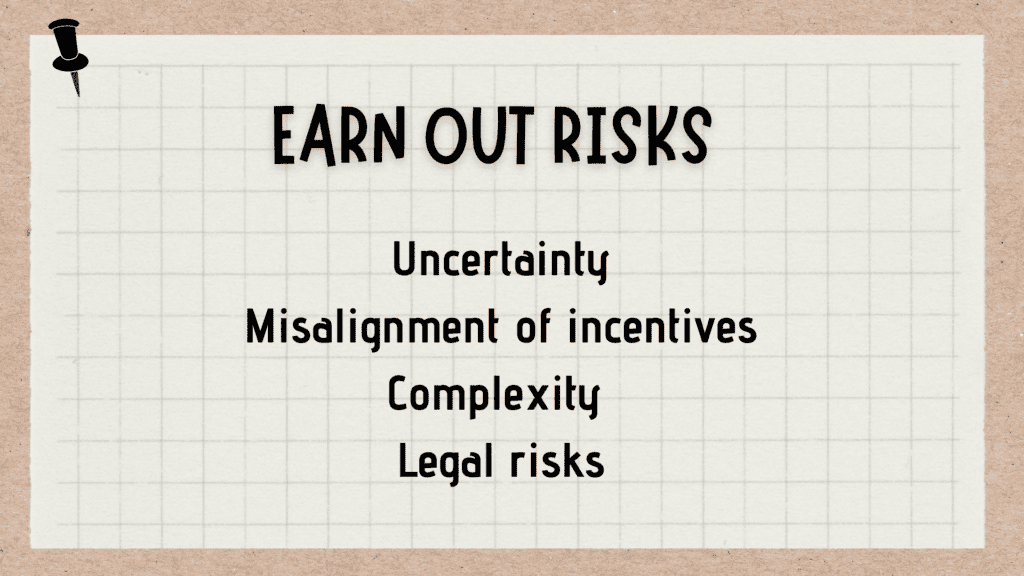
Here are a handful of risks associated with earn out structures:
- Uncertainty: An earn out is based on the future performance of the business, which is inherently uncertain and can be influenced by outside factors. This means that the seller may not receive the full amount of the earn-out, or may not receive any payments at all, if the performance of the business does not meet the agreed-upon targets.
- Misalignment of incentives: An earn out can create misalignment of incentives between the seller and the buyer. For example, the seller may be motivated to focus on short-term results and performance metrics rather than long-term value creation. On the flipside, the buyer may be more interested in building a sustainable, long-term business.
- Complexity: Earn out structures can be complex and may require ongoing negotiations and discussions to determine the final payment amount. The buyer and seller may have different expectations or interpretations of the earnout terms, which could lead disagreements and confusion.
- Legal risks: Earn out structures may be subject to legal risks, such as disputes over the interpretation of the terms of the agreement or the calculation of the earn-out payments. These disputes can be costly to resolve and may result in delays or other negative consequences for both parties involved.
Frequently Asked Questions
Why use an earnout?
An earnout can be a good option for both sides of a transaction. It allows the buyer to potentially pay a lower upfront price while still offering the seller the opportunity to benefit from the continued success of their business.
For small business owners, earn outs can be a particularly useful tool for maximizing the value of their business. Many small business owners pour their heart and soul into their businesses, and an earnout can provide a way for them to continue to be rewarded for their hard work even after the business has been sold.
How does an earnout work in an acquired company?
An earn out is typically structured as a percentage of the purchase price, and is triggered based on the achievement of certain financial goals or milestones.
For example, the seller may receive additional payment if the business reaches a certain level of revenue or profit over a specified period of time after the sale.
What metrics are used to determine the earn out and purchase price?
The metrics used to determine the earn out can vary depending on the specific circumstances of the sale.
Common metrics include revenue, profit, customer retention, or other measures of future growth.
How long does an earnout last?
The length of an earnout period varies (and is negotiable) but it’s typically a three to five year period after the sale.
Who determines the terms of the earnout?
The terms of the earnout should be clearly defined in the purchase agreement, and should be negotiated between the buyer and the seller.
I’d recommend you work with a knowledgeable attorney or M&A advisor to protect yourself and ensure that the earn out terms are fair and reasonable.

How is an earn out paid?
The earnout is typically paid in multiple payments over the course of the earnout period.
These installments may be paid out periodically (e.g., quarterly or annually) or in a lump sum at the end.
Are earn outs taxed as capital gains?
Earnouts are generally taxed as ordinary income, so it is important to consider the tax implications of an earnout when negotiating the terms of the sale.
As I mentioned above, make sure to consult your M&A advisors.
What happens if the business does not meet the earn out goals?
If the business does not meet the earnout goals, the seller may not receive the full amount of the earnout.
The terms of the earnout should be clearly defined in the purchase agreement, including any contingencies or provisions for partial payment.
Can the earn out be renegotiated?
It’s generally not possible to renegotiate the terms of the earnout once it has been agreed upon in the purchase agreement.
With that said, the terms of the earnout can be renegotiated if both parties agree to do so. I wouldn’t bank on it – as this would be a rare scenario.
What happens if the business is sold again during the earn out period?
If the acquired company is sold again during the earn out period, the terms of the earnout may be impacted.
It’s important to carefully consider the potential impact of a future sale when negotiating the terms of the earnout.
Can the earn out be deferred?
In some cases, it may be possible to defer the earnout until a later date.
This can be a good option if the business is not yet performing at the levels needed to trigger the earnout.
Can the earn out be accelerated?
In some cases, it may be possible to accelerate the earnout if the business is performing exceptionally well. This can be a good option for both parties, as it allows the seller to receive the full earnout sooner and the buyer to potentially recoup their investment more quickly.
What happens if the business owner dies during the earnout period?
If the business owner dies during the earnout period, the terms of the earnout should be clearly defined in the purchase agreement.
In some cases, the earnout may be paid to the owner’s estate or to a designated beneficiary.
Wrap Up
In certain situations, earn outs can be a useful tool for small business owners looking to break through negotiation challenges and sell their businesses.
Although there are some risks associated with this type of structure, these risks can be mitigated by carefully negotiating the key elements of the earn out and doing your homework.
By carefully considering the terms of the earn out and working with a knowledgeable attorney or financial advisor, business owners can maximize your total purchase price and ensure a smooth transition to the new owner.
I hope you found this post helpful, feel free to let me know if you have any questions in the comments.
If you’re interested in a deeper dive, this is part of a series of posts related to mergers and acquisitions:
- Selling a Business Checklist: 32 Tips to Sell For Top Dollar
- Business Exit Strategy: How to Find the Perfect Buyer for Your Small Business
- Business Exit Planning: Want to Prepare Your Business for Sale? (16 Ways)
- Business Value Drivers: 20 Ways to Boost Your Exit Valuation
- Seller Notes: Exactly What You Need to Know Before Selling (7 Tips)
- 3 Surefire Ways to Increase Your Small Business Valuation Multiple With M&A Arbitrage

