If you’re like most small business owners, you’re always looking for ways to save money and reduce your tax liability.
The good news is, business owners are some of the most tax-advantaged folks in America. In this article, I’ll walk through 15 small business tax planning strategies to help you save on taxes.
Digging into tax laws and implementing these tips and can save you thousands of dollars each year.
Please note that this post is purely for informational purposes and does not constitute as financial advice. As always, consult a qualified tax professional before making any decisions.
15 Small Business Tax Planning Strategies
- Use The Augusta Rule
- Hire Your Children and Get Tax Benefits
- Use the QBI Deduction to Reduce Your Tax Bill
- Take Advantage of Business Tax Credits
- Buy Qualified Small Business Stock (QSBS)
- Maximize Retirement Contributions
- Installment Sales to Reduce Your Tax Bill
- Utilize Deductions for Business Expenses
- Reassess Your Accounting Method
- Asset Depreciation Strategy
- Claim Home Office Deductions
- Take Advantage Of Tax Losses
- Defer Income
- Evaluate Your Business Entity
- Take Out Loans From Your Business
While I typically write about growth strategies and profit-boosting opportunities, this is a critical topic worth spending some time on.
By taking advantage of these tax planning strategies, you can better manage your finances and maximize your tax deductions.
It’s important to understand how each strategy works in relation to your individual situation so that you can maximize savings while staying compliant with applicable laws.
Let’s dig in.
Use the Augusta Rule
The is one of the easiest tax planning strategies to implement but is very rarely talked about.
The Augusta Rule states that you can rent your house to your business for the following purposes:
- Member events (customer/client events, workshop, or mastermind)
- Employee meetings (team offsite, strategy meeting etc.)
- Recording (creating content or videos relating to your business)
This means you can lease your home to your business for up to 14 days (at a fair market rate) to generate both tax free income and a tax deduction.
For instance, let’s say you hold an employee meeting at your home at a fair market rate of $1,000/per day.
If you bill out your home for 14 days, you can write yourself a tax-free check for $14K and take a tax deduction for that amount.
The Augusta Rule is known as Section 280A to the IRS, and while you want to ensure you can defend the fair market rate you use, this is one of the best little-known tax deductions out there.
Hire Your Children and Get Tax Benefits
If you have kids under 18 years old, you can legally hire them to work for your business. The tax law allows you to pay their salary and any additional benefits, such as healthcare coverage, tax-free.
This strategy also allows for money to be transferred from the business to the child’s bank account without being taxed as income. It’s a simple way to pay your kids and save on taxes at the same time - you can pay them up to $12,950 tax-free and deduct this amount from your taxable income.
Your child will owe $0 in taxes and you avoided tax on $12,950.
A couple caveats:
- The child has to perform an actual task and be paid a reasonable wage
- Check your state specific requirements for additional details
Use the QBI Deduction to Reduce Your Tax Bill
The Qualified Business Income (QBI) deduction is available to small business owners and self-employed individuals who meet certain income requirements. This deduction allows you to deduct up to 20% of your income from taxable income - potentially reducing your taxes significantly.
To qualify for the QBI Deduction, you must:
- Have a domestic trade or business
- Have “qualified business income” (with some exceptions)
- Meet certain filing requirements

Take Advantage of Business Tax Credits
There are several business tax credits available to small businesses that result in a dollar for dollar reduction in your tax liability.
If you qualify, these credits can make a significant impact. Here are a handful of examples:
- Research and Development (R&D)
- Work Opportunity Credit
- Investment Credit
- Credit for Small Employer Health Insurance Premiums
Take time to explore all available options from the IRS before filing your taxes.
Buy Qualified Small Business Stock (QSBS)
Qualified Small Business Stock (QSBS) allows you to purchase stock in qualified small businesses without having to pay capital gains tax on the sale of that stock.
This can be an incredibly useful tax planning when looking to increase your investment portfolio while reducing your tax burden.
As Michael Girdley explains on his blog, here’s how the strategy works:
1) Buy stock in a US federal C-corporation
2) Sell it after five years
3) You pay 0% capital gains taxes on the greater of $10 million or 10x your investment
Keep in mind you must meet certain requirements to qualify for QSBS, so make sure you do your research.
Maximize Retirement Contributions for Tax Savings
One of the most effective ways for to drive tax savings is to maximize contributions to retirement plans.
Since you are self-employed, you have more flexibility with retirement plan contributions compared to W2 employees.
When you invest in a retirement plan such as a SEP-IRA or 401(k), you can deduct those contributions from your business income, reducing the amount of taxes you owe.
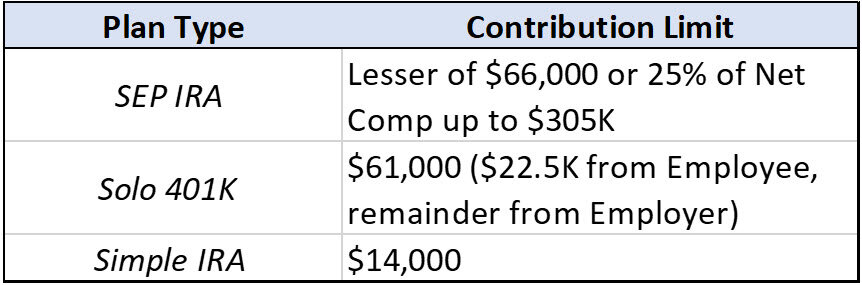
Here’s a breakdown of retirement plan contribution limits (as of 2022):
Installment Sales to Reduce Your Tax Bill
If you’re planning to sell your business, you might want to consider taking on a seller note as part of the deal.
Here are a few advantages:
- Defer gains to the year you receive payment
- Earn interest on the note
- Spread out the payments over a period of time, thereby reducing your tax obligation in any given year.
Talk to a qualified CPA or tax attorney to determine if installment sales are worth considering as a tax planning strategy.
Utilize Deductions for Business Expenses
Many business owners overlook certain tax deductions that can help reduce their business taxes.
The IRS allows you to deduct certain expenses related to the business operations. These deductions can help reduce your taxes and maximize your savings.
Common deductible expenses include:
• Employee wages
• Advertising/marketing costs
• Travel and entertainment expenses
• Office supplies and equipment
• Professional services (legal, accounting, etc.)
• Property taxes
• Rental/lease expenses
• Bank fees and interest paid on business loans
• Business insurance premiums
Keep an eye out for industry-specific tax deductions as well.
Be sure to consult a qualified tax professional to make sure you’re taking advantage of all the deductions available to your business.
Reassess Your Accounting Method
Typically small businesses can choose whether to use accrual or cash accounting methods, which can influence your tax planning strategy.
Which accounting method you choose will make a difference on how and when you’ll pay taxes.
The cash-basis accounting method records income at the moment it is received, while accrual basis accounting records income when it is earned regardless of when money changes hands.
If your business pays out large expenses towards the end of the year and receive most of its income early in the year, then cash-based accounting may be more beneficial for tax purposes. On the other hand, if your business has consistent sales throughout the year, then an accrual-based system might provide more benefits.
Depending on your situation, you might be able to reduce your taxes by:
- Expensing small capital expenditures
- Accruing compensation paid after year-end
- Using inventory methods that increase cost of goods sold
Asset Depreciation Strategy
Asset depreciation is a tax deduction that allows businesses to deduct the cost of certain capital investments over time.
This can be especially beneficial for small businesses since it gives them an extra incentive to purchase items, such as equipment and software, necessary for business operations.
As of 2022, tax regulations allow small business owners to accelerate 100% of the depreciation of tangible short-life assets (under 20 year life).
This is a substantial benefit when it comes to reducing tax liabilities, as cost segregation can push costs from “long life” to “short life” and qualify those costs for bonus.
Talk to your tax advisor about the best way to take advantage of this opportunity.
Claim Home Office Deductions
If you use part of your home exclusively for business purposes such as a dedicated office space or storage area, you may be able to deduct a portion of your mortgage interest or rent payments on your taxes.
You will need to calculate a percentage of your total household expenses (mortgage/rent, utilities, etc.) based on the square footage used for business purposes.
The IRS allows up to $5 per square foot as a standard deduction for home offices. Make sure to save receipts related to office supplies and any other costs that qualify for deduction.
To qualify for the deduction, the space must be used regularly and exclusively for business purposes. It’s important to consult a tax advisor before claiming home office deductions as there are certain rules and limitations that apply.
Take Advantage Of Tax Losses
If your business has had losses during the year, they may be able to help reduce taxable income through net operating loss (NOL) deductions.
NOLs are used to offset income from other sources and is worth considering for your tax planning strategy. It’s important to keep in mind that if you experience a net operating loss in one year, you may be able to carry it over into the next year for additional savings.
This technique can provide significant tax savings, especially if you have a significant number of investments.
Defer Taxable Income
You can also reduce taxes by deferring taxable income. This involves delaying the receipt of income until the following year, allowing you to spread out the impact of taxes across two years instead of one.
For example, if you’re an independent contractor, you may be able to contract with your clients so that they pay a portion of the fee at the beginning of the year and a portion at the end. This can help reduce your tax payments in any given year, while still providing you with an expected income stream.
You may also be able to delay payment of bonuses or other forms of compensation until after the new year.
A few more ways to do this:
- Delaying invoices
- Doing longer contracts
- Offering discounts for prepayment

Deferring income can help you spread out your taxes over multiple years, giving you more flexibility and breathing room when it comes to managing your business finances.
It’s important to note that these strategies should only be used if you are sure that you will be able to pay your taxes at the end of the year. If in doubt, consult a tax advisor to discuss your options.
Evaluate Your Business Entity Type
The type of business entity you have formed can influence your tax obligations and filing requirements.
Evaluating your current entity type and considering other options may help reduce your taxable income and ultimately the amount of taxes you owe.
A few examples:
- Corporations are subject to double taxation on both the company level and shareholder level, while pass-through entities such as LLCs or partnerships only pay taxes once.
- If you’re a sole proprietorship, your income is taxed at your personal tax rate. But if you form an LLC or S corporation, you can save money by paying yourself a reasonable salary and having the rest of the business profits taxed at lower corporate rates.
Utilizing the right business entity for your specific situation may significantly reduce your tax burden. Talk to a qualified CPA or attorney to help determine which entity makes sense for your situation.
Take Out Loans From Your Business
As you consider tax planning strategies, it might be worth talking to your tax advisors about potentially taking out loans from your business.
As Alex Hormozi explains in the video below, the ultra-wealthy often don’t sell their businesses - they instead opt to “buy and hold” while taking out loans against their business.
Loans against your business are not treated as income (tax free) but it allows you to spend money to live your life (i.e. day-to-day expenses, charitable contributions, and anything else you’d like to).
The ideal way to do this is to have the assets (your business) appreciate and generate more than loan repayments. This allows you to pour money into assets that continue to compound while also de-risking your position and having the ability to take out cash.
Instead of selling with a full exit event (with big-time tax implications), you can take out money from asset-backed loans, put that money into other assets, and not pay income taxes on the loans.
If you’re interested in exploring this approach, here’s a video (8 minutes) to check out:
Stay Current on Tax Laws for Small Business Owners
Make sure you stay current on tax law changes and regulations as you consider your tax planning strategies. Tax law changes can significantly affect how your business is taxed, influence potential tax credit and deductions, and the amount of taxes you owe.
Keep up-to-date with any news related to federal, state and local tax laws and regulations so that you don’t miss out on potential savings opportunities. If a new regulation goes into effect, it could potentially save you thousands in taxes if you’re aware of it in time to take advantage of it.
A qualified CPA or accountant can also help provide more detailed advice about how changing tax laws may affect your business’s bottom line.
Conclusion
These are just a handful of ways small business owners can reduce their taxable income before filing and paying taxes.
A thoughtful tax planning strategy can be the key to reducing taxable income and keeping more money in your pocket each year. Carefully review all deductions and consider how different strategies might impact your bottom line.
As I mentioned in the article, be sure to speak with an experienced CPA or tax attorney for additional details and guidance when preparing your business taxes.