
In this post, you’ll learn how to use an ascension model in your business to expand your business model and boost profit.
In recent conversations with business owners, I’m continuing to hear a common theme: “I need to grow my business…I just need to get new clients.”
But here’s the thing – the single most difficult and expensive thing to do in any business is to acquire a new customer. Depending on what industry you’re in, it costs anywhere from 5 – 25 times more to acquire a new customer than to retain an existing one (HBR).
My goal is to give you not only a vision of what’s possible, but equip you with actionable information you can use to expand your product suite for your existing customers and clients.
I see a tremendous number of small business owners leaving income on the table, and I don’t want you to be one of them.
What is an Ascension Model?
An ascension model (sometimes referred to as a “value ladder”) is a marketing framework and business model designed to move existing customers from one product or service offering to the next, in order to increase their value over time.
At its simplest level, an ascension model gives clients and customers multiple options for purchasing the same product or service at different levels of commitment and cost. For example, you may offer your product suite in different tiers – free, basic, silver, gold and platinum program – each with increasing features and benefits.
The goal is to gradually convert existing customers into higher-paying clients so they join your other offers and spend more money over time. This creates long-term customer loyalty and increases customer lifetime value.
Ascension Models and the 80/20 Principle
A lot of business owners assume their customers are roughly equal and have about the same willingness to buy. But in reality, that couldn’t be further from the truth – customers are NOT created equal.
The 80/20 rule is a major factor here, which is a universal truth around the imbalance between inputs and outputs. The basic idea is 80% of the results come from 20% of the effort (or inputs). On the surface it appears to be a simple, and while it’s not complicated, it’s a profoundly useful tool for businesses to focus their efforts and resources.
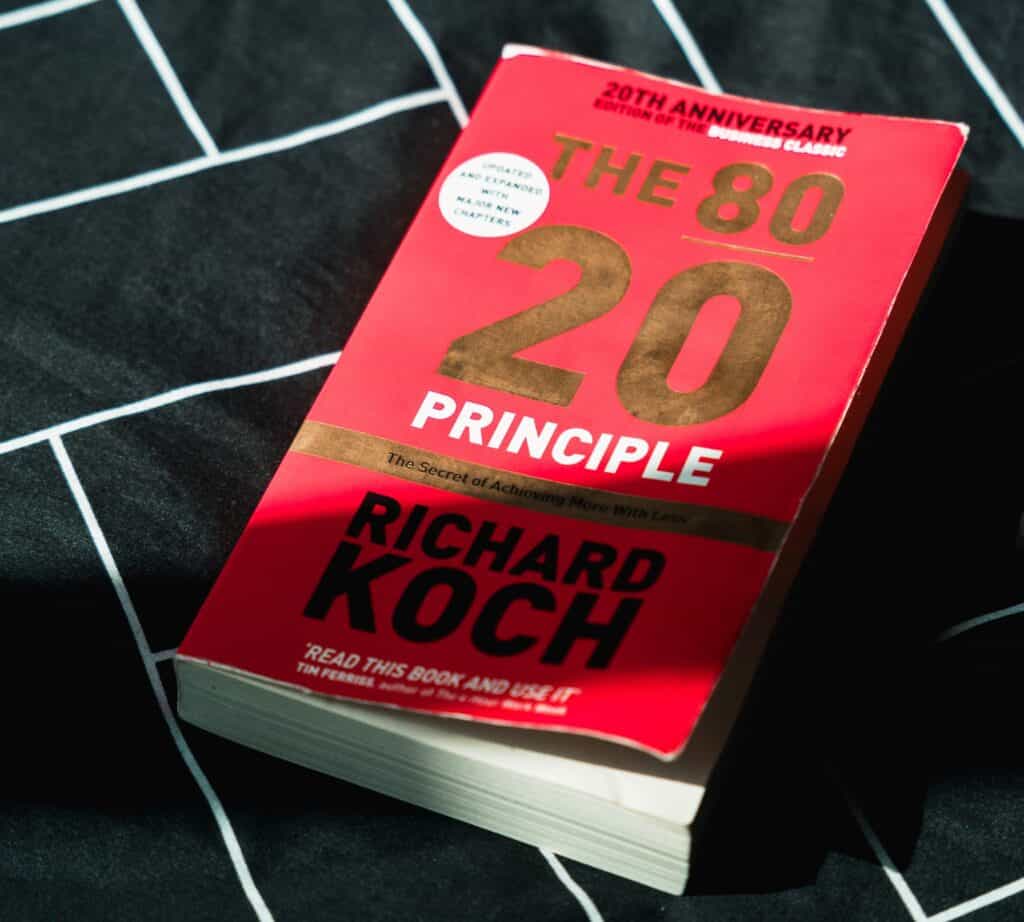
The Law of 80/20 says that:
- 20% of the customers produce 80%+ of the profits
- 5% of the customers produce 50%+ of profits
- 20% of the people will spend 4 times the money, and 4% of the people will spend 16x the money of the average person.
The real power of 80/20 is when we realize that 80/20 is fractal, containing patterns within patterns. Each 80/20 has an 80/20 relationship within it and everything in your marketing and business is a source of potential leverage.
What does this mean? You likely have 0.8% of your customer base worth 52% of your profits.
The percentages might not be exact but this law applies to virtually every industry, product, and service. By strategically targeting your top customers, you can radically transform your results, customer lifetime value, and create a sustainable competitive advantage.
Perry Marshall (author of 80/20 Sales and Marketing) talks about this idea in terms of an analogy, calling it the “expresso machine” principle.
He uses an example we’re all familiar with: Starbucks coffee. Starbucks has the following product suite:
- Grande Coffee for $2.10
- Mid-Level Expresso Machine for $275
- High-End Expresso Machine for $2,700 – over 100X more expensive than regular coffee
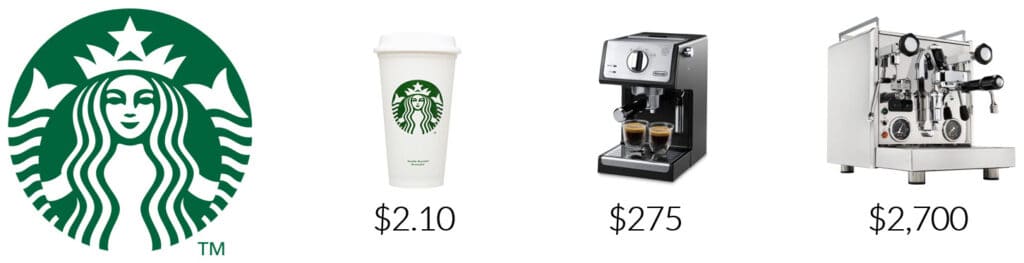
Most folks don’t realize Starbucks even sells that high-end expresso machine. Believe it or not, there are actually a decent number of people willing to buy that high end machine.
There are always going to be a significant portion of past clients and customers willing to spend more…and I’m willing to guarantee this is the situation in your business too. A lot of companies don’t understand this.
Ascension Model Example
Let’s look at a well designed ascension model through how Tony Robbins has constructed his business. As you can see in the ascension pyramid below, as you go higher up, prices go up dramatically. The pyramid and customer journey contains everything from free content to top level coaching program that costs $1M+. This top tier is very attractive to his ideal client.
Said differently: the closer you get to Tony, the more you have to pay.
The idea behind an ascension model is to start with a large group of people at the free level (the bottom of the pyramid) and then gradually narrow down that group until you’re left with your most valuable customers.
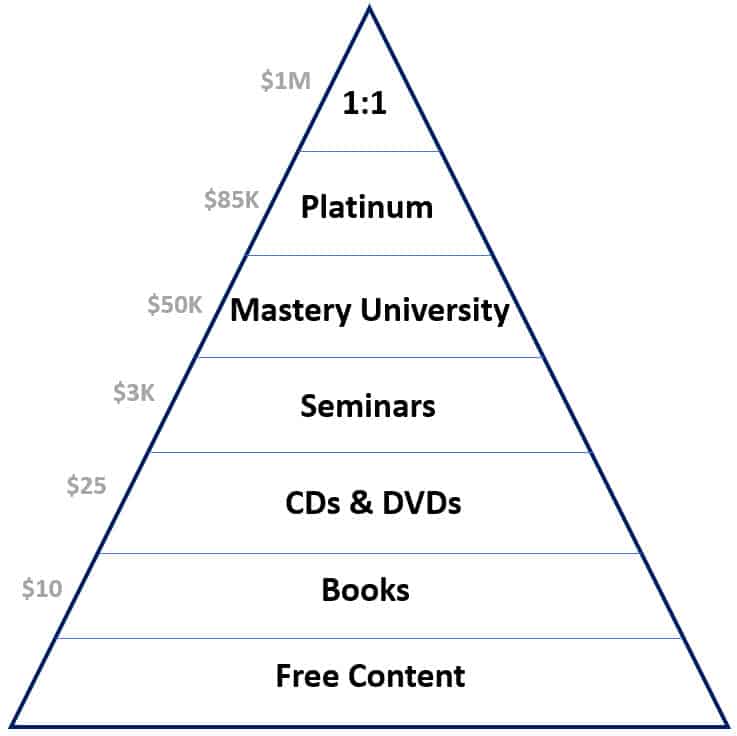
At the bottom of the pyramid, if he did nothing but sell books, Tony would be leaving a tremendous amount of money on the table. While he’ll capture a large segment of the market at the low cost level, there are always an elite few that will climb all the way to the top of the ascension model.
These people are willing to pay top dollar for personal attention (i.e. personalized coaching) and the likelihood for a greater result.
Optimize Your Market Offerings
Here’s the punchline: if you’re not selling premium high ticket offers with an ascension model you are leaving a ton of income on the table.
I can tell you this unequivocally – there is a portion of your customer base that want more from you (this is true in every business). According to world-class marketer Dan Kennedy, 5 – 20% of your customers are not fully satisfied. These top customers will spend more money with you if given the chance.
Even if 95% of your customers do not have a willingness to spend a lot of money (similar to Tony’s books), that 5% could be worth 50% for the bottom line of your business.
Therefore, it’s critical that you identify and focus your efforts on your most valuable customers.
Creating an Ascension Business Model
Beyond the benefits we covered above, high ticket items are a great way to expand your produce suite and increase your lifetime customer value. From a profit standpoint, the premium versions also tend to have far higher profit margins than your core/base offering.
Keep in mind your high ticket offer should be a natural extension of your basic offer, but should have greater usefulness and be sold at a significantly higher price.
Crafting a high ticket offer doesn’t have to be complicated. In fact, it can be quite simple. Here are a few tips to get you started:
1. Start by evaluating your basic offer. What are the key components that make it valuable? What could you add or change to create an even more valuable offer?
2. Think about what your ideal potential customers and clients would be willing to pay for your product or service.
Think about ways it can have a significantly higher perceived value than your basic offer.
Here’s what I’d ask you to think about:
- How can you dramatically improve your client experience?
- What would you have to do to add great value?
- Can you add tiers to your products or services? Can you create a premium program?
- How many price levels do you serve (starting with free)?
Example Ideas to Consider For Your Ascension Model
- Hands-on help: This could be through individual or small group coaching program (training and personal help, as you lead to an end result)
- Increased personal touch, service, and priority access
- Done-for-you services: make it easier for clients – they might pay for learn how to do something but will pay more for you to do it for them!
- Simplicity, convenience, ease of use
- Workshops, clinics
- Toolbox: could include a variety of ads, tools, or other templates.
- Extended warranty, lifetime replacement, free repairs
- Lifetime membership: unlimited use, replacements etc.
- Exclusivity: part of a special club
- Package deal / bundles
- Speed: people will always pay for to get something done faster (i.e. overnight FedEx shipping)
- Higher quality materials
- Personalization: customized to the individual instead of ‘one-size fits all’
Here’s the vision of what this looks like:

As you consider expanding your product and service offerings, direct contact and personal support should be your top tier. As you work up the scale, few people will purchase but it’s for a dramatically higher price. This is all about premium and personal service for a select few number of clients.

The principle here is incredibly powerful. If you sell one product for $50, there is a subset of your customers that has the propensity to spend a LOT more than that if you scratch the right itch.
So you could add a $500 product and a $5,000 product that could likely double your overall sales.
The question to be thinking about is:
If I had to sell my product for $5,000, how would I do it? What would I have to do to ramp up value I deliver to my customers?
Ascension Pyramid for Your Top Customers
As you continue your brainstorming, the natural next question is: How do I find out what they want to buy?
The first step is to identify the top 20% (or even top 5%) of your customers and design products specifically for them.
Once you come up with the list of these individuals, I’d recommend you call them and ask a few questions. It does not have to be complicated and you can phrase this as just asking for their advice.
Here are a few thought-starter questions you can use when you talk to them:
- “What would you definitely buy from us if we were only smart enough to offer it to you?”
- How should we package our product / services?”
- “Is there anything else we should be offering you that you’d want to go with ____________.”
The key here is that we validate what we create through asking them (we want to get a sign of their interest). As you or your sales team continues to have these conversations, you’ll likely hear some similar themes from your top customers.
You’ll want to start to get clear on defining what this looks like:
- What is the high ticket offer you could start selling?
- Can you go all the way from free up to a high-level program?
- What are the features and benefits of this product, service, or coaching?
- How is your offer different from other offers on the market?
Once you’ve answered these questions, you’ll be able to deliver a compelling offer that will resonate with your target audience. Remember, this is not intended for everyone, just that subset of top customers.
Whatever it is, you need to be able to clearly articulate the value proposition of your to your target market. This will help you attract and retain the most valuable customers who are willing to pay more for what you are creating.
What’s Next?
As we close, I’d ask you to implement just one of the ideas we talked about in your business next week. I hope I’ve inspired you to give this a try and I hope it helps you reach your income and financial goals.
The faster you put it an ascension model into action, the more likely you’ll see results. Don’t let perfection get in the way of progress – this is all about implementation.

