
As a business owner, it’s essential to get clear on who your most profitable customer segment is. A customer profitability analysis can help you quickly identify those customers who bring in the most revenue and maximize your profits.
In this post, we’ll dive into the topic of customer profitability analysis and share a four step process for finding your most profitable customers. By the end, you’ll have the knowledge you need to make strategic decisions that can lead to increased profitability and business growth.
What is Customer Profitability Analysis?
Customer profitability analysis (CPA) is a process that enables businesses to quickly determine their most and least profitable customers. At it’s simplest level, it involves evaluating the revenue generated by individual customers and comparing it to the costs associated with serving those customers (i.e. marketing costs, shipping costs, and customer support costs).
Customer profitability analysis allows businesses to quickly identify the customers who contribute the most to your bottom line, and those who may not be worth the investment of your time, money, and resources.
By identifying your most profitable customers, you can prioritize them and allocate your resources to serve them better, increase their loyalty, and expand your business with them.
It’s worth mentioning that CPA is similar to an RFM analysis – both are very useful tools for understanding customer behavior and driving revenue growth. For a deeper dive, I’d recommend checking out my detailed post on RFM customer segmentation.
80/20: Your Most Profitable Customer
You’ve likely heard of the 80/20 rule (also known as Pareto’s Principle) but I often find business owners don’t harness its full potential.
The basic idea is that there are inequalities between cause and effect: 80% of the results coming from 20% of the effort.
But that’s just the surface.
80/20 applies to pretty much everything in business that you can count or measure, and is an incredibly underrated tool. A small number of factors will always be responsible for the majority of results.
80/20 can be applied in a lot of ways (including finding your most profitable products), but for this post we’ll focus on the small number of customers generating the vast majority of sales.
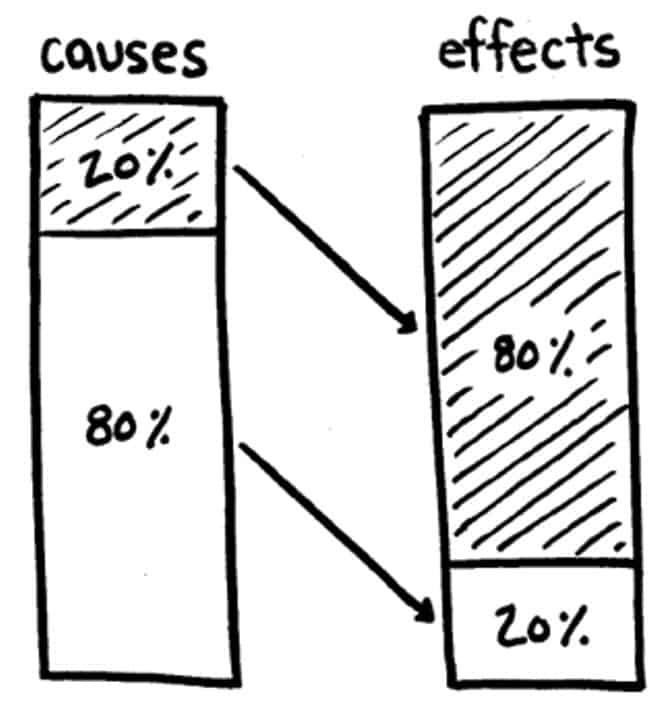
The Vital Few And The Trivial Many
In my experience, when you dig under the covers of any business, you find a few things working incredibly well along with a ton of inefficiency and complexity (unprofitable products, customers, suppliers, etc.).
By understanding where the greatest results come from, you can allocate your resources more effectively and get phenomenal results.
By focusing on these key areas, you can make significant improvements with relatively little effort. At first glance, you might think 80% of your profits come from 20% of your customers.
In practice, the imbalance between cause and effect is often times far greater than 80/20.
Almost no one realizes that 80/20 is fractal, which means it has an endlessly repeating pattern (there is an 80/20 inside each 80/20).
What does this mean?
It’s likely that 95% of your profit is within 5% of your customers. Said differently: your top customer segment is likely to create more profit than all your others combined. I can almost guarantee it.
This gets really exciting once we figure out who those top customers are, and exclusively focus on attracting more customers with that exact profile. You can become intentional about exactly who you choose to serve and more importantly, who you choose not to.
What if 100% of your customers were in that top segment?
You can pick better customers, have fewer headaches, and massively grow your business.
As a result, you’d likely be able to triple your business (or more) without increasing your sales volume.

Customer Profitability Analysis: Step by Step
The natural next question is: how can you conduct a customer profitability analysis within your business? Let’s dig in.
Step 1: Survey All Existing Customers
You want to do all you can to encourage customers to share their perspective, so I’d recommend giving an incentive (like a discount or free bonus) for completing the survey. The easiest way to do this if you’re able to get customers to share feedback during a live phone interaction.
Here’s the information I recommend asking:
Demographics / Background
- Age
- Gender
- Family Situation (married with kids, single etc.)
- Political Affiliation
- If B2B: number of employees, partners, years in business
- Geographic Location
Before / After Statistics
Note that this will be tailored depending on if you’re B2B or B2C:
- For B2B: business size (revenue/profit) prior to working with you
- Major challenges and pain points prior to working with you
- Length of time it took to see results from your product or service
- Results after working with you
Aspirations
- What were their goals when they first purchased from you?
- What outcome were they looking to achieve?
Buying Process
- Was there a specific trigger that caused them to buy?
- What was their decision criteria?
- What other competitors did they consider?
- Was there a specific testimonial or customer review that convinced them to buy?
- What do they see as your main area of differentiation?
- How did they first hear about you? Were they referred to you, find you organically, through paid ads etc.
Step 2: Rank Customers Who Have Spent the Most
Once you’ve surveyed your customer base, sort your results by customers with the highest customer lifetime value.
These are the folks that have spent the most with you during their buying relationship with you.
You should be able to quickly export transaction history (average purchase size, frequency of purchases, etc.) to get this information. If possible, you’ll want to match the customer profit with the cost to acquire these high value customers.
For the intent of this exercise, we’re only going to look at the top 20% of customers – ignore the rest.
Step 3: Find Commonalities
This is the most important step and where you’ll find the gold. This takes some focused effort but it’s well worth taking your time here.
Match up the customers that you’ve uncovered in step two and look for commonalities. Examine their demographics, buying process, aspirations, results achieved, etc.
The goal is to narrow it down as much as possible by finding the threads that they all share. By the end, you’ll likely be able to find a handful of things they all have in common.
Start to create a profile of your ideal customer avatar based on the similarities in your top group (age range, family situation, location etc.). This takes time, but you’ll eventually be able to create a customer segment based on the key characteristics.
By this point, it will be fairly easy to see how much more profitable each of customer generates compared to your “average” customer.
I think you’ll find this eye-opening: everyone I’ve ever done this exercise with has been blown away with how much more profitable these folks are.
Step 4: Adjust Your Approach
Revise all of your marketing messaging
You want to specifically speak to the handful of common attributes of your ideal customer group (i.e. 40-50 years old, located in Northeast, 8 employees, average business size of $2M).
This will create some powerful shifts in your marketing messaging – you’ll want to tailor everything to speak to their pain points, challenges, and aspirations.
As a byproduct, you’ll attract more of these ideal customers and repel those that don’t fit the bill. This allows you to be very intentional about who you bring into your business, and create new customer requirements around who you serve.
Once you know this information, I strongly advise that you get stricter about who you work with. Be willing to say no to less profitable customers that don’t meet the criteria. This can be scary at first but it’s crucial to making this strategy work.
By narrowing down your customer profile to a small slice, you are able to reposition yourself to be the best in the world at serving this group.
You’re no longer competing with everyone, which can allow you to dominate. If you’re interested a deeper dive into why this works, I recommend checking out ‘Star Principle‘ by Richard Koch.
Reverse engineer your sales process
What influenced your top customers to purchase your product or service? Do all you can to re-create buying experience of this particular customer segment.
A few ideas:
- What were the reasons the best customers purchased? Build this into the customer onboarding journey and value ladder for every prospect
- Which acquisition channel did they come from? Double down on this channel (as an added bonus, it will likely lead to lower customer acquisition costs)
- Create content to appeal to the main challenges and pain points they have
- Focus your marketing efforts on your most profitable customers. This can include targeted advertising and promotions that speak directly to their needs and preferences.
- Stop trying to appeal to everyone and be ‘one-size-fits-all’ – be hyper-focused on this customer segment
Importance of Customer Profitability Analysis
The advantages of calculating customer profitability and serving better customers can be pretty incredible:
- Higher profit margins
- More referrals
- Fewer headaches
- Lower churn and improved customer retention
- Higher conversion rates (due to laser targeted messaging)
- Greater customer lifetime value
- Allow you to charge significantly more for your products or services
As I mentioned above, to attract and retain your ideal customers, it’s super important that you’re willing to let go of unprofitable customers who drain your energy and resources.
Focus on tailoring everything from your messaging to your sales process and customer journey to your specific target audience. By doing so, you can convert them at higher rates and provide more value – everyone wins.
By segmenting customers and focusing on your ideal customer avatar, you can create a more choreographed sales process and fulfillment process that is far more tailored to their specific needs and situation.

Conclusion
Measuring customer profitability is crucial for any business that wants to grow and succeed. By identifying your most profitable customers and focusing your resources on serving them better, you can increase revenue, improve retention, and boost your profit margin.
As an added bonus, by being more selective about who you serve, you create an opportunity to dominate in a certain customer segment and establish yourself as the leader in that space.
I hope you take this to heart, because it can take your business to the next level and massively increase your overall profitability.
Good luck!



