
Tuck in acquisitions can be a powerful tool for any business owner looking to grow their company quickly and efficiently.
In this post, I’ll show you how tuck-ins can help you maximize your growth potential and give you a 6-step roadmap to kickoff the process.
Let’s get started.
What is a Tuck In Acquisition?
A tuck in acquisition is a type of acquisition in which a larger company buys a smaller company that is in a related line of business, and “tucks” it into its existing operations. You’ll frequently see this strategy used by private equity companies for their portfolio companies, but it’s possible for businesses of all sizes.
Tuck-in acquisitions are typically smaller in scale than standalone acquisitions, and are often used by companies to expand their product or service offerings, enter new markets, or acquire new customers in a short period.
Benefits for the Acquiring Company
- Speed: a tuck in acquisition allows businesses to quickly and easily expand their product or service offerings, enter new markets, or gain access to new technology or intellectual property.
- Cost savings: can be a cost-effective way to grow a business, since acquiring smaller companies that are complementary to existing operations of the larger company is usually much cheaper than building from scratch.
- Synergies: tuck in acquisitions can create synergies between the acquiring company and the acquired company, allowing the combined entity to operate more efficiently and effectively.
- Increased customer base: by acquiring a company that already has a strong customer base, businesses can quickly and easily expand their reach and bring on new customers.
- Lower risk: tuck ins are less complex to execute than standalone acquisitions, as the acquiring company is able to leverage its existing infrastructure and resources to integrate the acquired company.

Tuck In Acquisition Examples
What are some examples of companies that have successfully used this strategy? Let’s take a look at a few you might recognize:
- In 2018, Google acquired Redis Labs, a startup that provides in-memory data storage solutions, in order to add Redis Labs’ technology to its cloud computing platform.
- In 2019, Salesforce acquired Tableau, a data visualization company, in order to expand its analytics and data visualization capabilities.
- In 2020, Amazon acquired Zoox, a self-driving car startup, in order to add autonomous vehicle technology to its delivery services.
- In 2021, Facebook acquired Kustomer, a customer service startup, in order to enhance its customer service capabilities and improve the user experience for its social media platforms.
Reasons to Pursue Tuck In Acquisitions
If you’re not yet convinced, here are some more advantages to consider when considering a tuck-in acquisition:
- Speed to market: faster, more efficient way to grow compared to organic growth
- Provide a ready-made customer base, which can help to quickly drive revenue growth
- Offer the opportunity to quickly expand into new markets and extend the geographic reach of existing products and services (or into a whole new industry all together)
- Increase scale and market presence
- Provide access to new technologies or capabilities
- Provide an opportunity for financial leverage, which can help boost shareholder value
- Can help a large company consolidate fragmented industries
- Bring together complementary teams and expertise, allowing small businesses to tap into new areas of knowledge and expertise
- Lead to greater economies of scale, which can help businesses to reduce costs and compete more effectively

Macroeconomic trends provide even more incentives to pursue a tuck in acquisition:
- 4.5 Million Businesses worth $10T will transition over the next 10 years – Exit Planning Institute
- 10,000 baby boomers retire on average each day, with 19% of them owning small businesses. This represents the greatest wealth transfer in history of the US – Forbes
- 80% of businesses don’t sell (LinkedIn). Many of these owners would likely be willing to sell for an affordable price instead of just closing their doors.
Bolt On Acquisitions vs. Tuck In Acquisitions
Bolt on and tuck in acquisitions are very similar – but let’s walk through a handful of the key differences. A bolt on acquisition refers to a company, usually larger in size and scope, looking to acquire smaller companies that will complement its current set of products or services.
- Scale: Tuck-in acquisitions are typically smaller in scale involving the acquisition of specific assets or lines of business rather than the entire company.
- Integration: Tuck-in acquisitions involve less integration with the acquiring company’s operations, as the acquired assets are simply “tucked” into the existing business.
- Risk: Tuck-in acquisitions tend to be less risky than bolt-on acquisitions, as the larger company is able to assess the viability of the acquired assets within its own operations before committing to a full acquisition.
- Cost: Tuck-in acquisitions are generally less expensive than bolt-on acquisitions, as they involve the acquisition of smaller assets or businesses. Typically this doesn’t require raising capital.
Risks of Tuck In Acquisitions
Below are a few risks you should consider when considering a tuck-in acquisition. As always, make sure you work with your M&A advisors and go through a proper due diligence process.
- Integration risk: Integrating the acquired assets into the acquiring company’s operations can be a complex, expensive, and time-consuming process, and there is always the risk that the integration will not go as smoothly as planned. This can lead to disruptions in the acquired assets’ operations, and may result in lost customers or revenue.
- Cultural risk: Culture can be a potential risk any time two companies come together. Different companies often have different cultures, and there is a risk that the culture of the acquired assets’ previous owner will not mesh well with that of the acquiring company. This can lead to conflicts and difficulties in managing the combined entity.
- Regulatory risk: Depending on the nature of the acquired assets’ business, there may be regulatory hurdles that must be overcome in order to complete the acquisition (including regulatory fees, etc.). If these hurdles cannot be overcome, the acquisition may not be able to proceed.
Tuck In Acquisition Strategy – 6 Ways to Grow
Now that you know the basics, let’s make this actionable for you.
What types of businesses would make sense to acquire for your company? It might seem like there are an infinite number of possibilities…where do you start?
I’m going to lay out 6 categories of potential options and recommend that you treat this as a brainstorming exercise.
The key is to think strategically and look to uncover the best adjacency opportunities for your particular situation.
When going through this process I want you to answer these 2 questions:
- Where area of your business is weakest and needs improvement?
- What is the missing piece for your next stage of growth?
Depending on your answers, there are six categories of bolt-on acquisitions that can grow the value of your business.
Which will help you the most? What you pick will lead you to what you should consider acquiring.
- Increase Market Share
- Increase Number of Leads
- Strengthen Team / Infrastructure
- Improve Average Order Value (AOV) and Lifetime Customer Value (LCV)
- Boost Innovation or Capabilities
- Increase Profit Margins
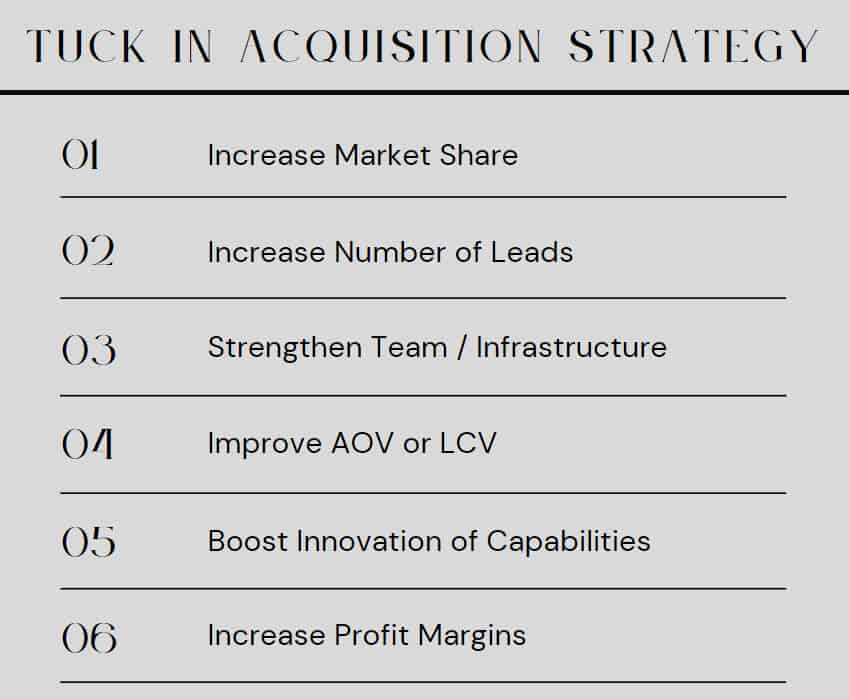
Let’s dig into each category:
Want to Increase Market Share?
- Acquire a Competitor: think about indirect and direct competitors to your business. This type of acquisition can help to quickly expand your customer base or geographical reach. Think about any companies that would complement your existing customer relationships.
- Examples: competitors in similar or different geographies, any substitute or replacement offerings in the market
Want to Increase Your Number of Leads?
- Acquire Media: everyone who aggregates the attention of your ideal clients would be an ideal acquisition opportunity (this could be a company or traffic asset that exposes you to new customers)
- Examples: print publications, digital media, TV broadcasting, email lists, podcasts, Facebook groups, blogs
Want to Strengthen Your Team or Infrastructure?
- Acquire Talent: think about other companies with employees who have expertise or skills that complement your existing workforce. This type of acquisition can quickly expand your pool of talent and expertise.
- Think about any teams and expertise that would help you: sales, marketing, R&D, engineering, marketing etc. Instead of starting these functional areas from scratch, you can acquire a fully formed team and simply plug them in to your existing operation.

Want to Improve Average Order Value (AOV) and Lifetime Customer Value (LCV)?
- Acquire a Product Vendor: any company currently providing products to your business or your customers. Think about product lines which can complement your existing product offerings. This type of acquisition can help to expand your product offerings and potentially tap into new markets.
- Acquire a Service Vendor: any company currently providing services to your core business or their customers is another prospective acquisition.
- Think about anything related to what you sell already which can help your current customers. Examples include an upsell, downsell, cross-sell, any types of substitute products/services, or a less expensive version of your existing offering.
- Can you use acquisitions to strengthen your MRR (monthly recurring revenue) using repeating services, auto-ship, or subscriptions?
Want to Boost Innovation or Capabilities?
- Acquire Intellectual Property (IP): this could include customer lists, patents, inventions, trademarks, licensing or standard operating procedures
- Acquire Technology: think about potential technology platforms that would complement your existing technology offerings. This type of acquisition can help to expand your technology capabilities and potentially tap into new markets.

Want to Increase Margins?
- Acquire a Supplier or Distributor: think about which target company’s supplier and distributor relationships complement your existing relationships. This type of acquisition can help to strengthen your current supply chain.
- Think about anyone you currently purchase from or any distribution channels your business or customers use. Are there any middlemen currently cutting into your margins?
Wrap Up
Regardless if you are a private equity firm or a small business owner, tuck in acquisitions can be a powerful way to rapidly grow and allow you to gain a competitive advantage.
By carefully identifying and evaluating potential acquisition targets, you can rapidly diversify your offerings and expand your customer base.
I hope this post helps you on your path to market dominance. Feel free to drop me a note in the comments if you have any questions.

